
The Story of Maya Chapter 5: The Loneliness of Leadership
The Story of Maya: An Unshakable Executive Leadership Series
Chapter 5: The Loneliness of Leadership
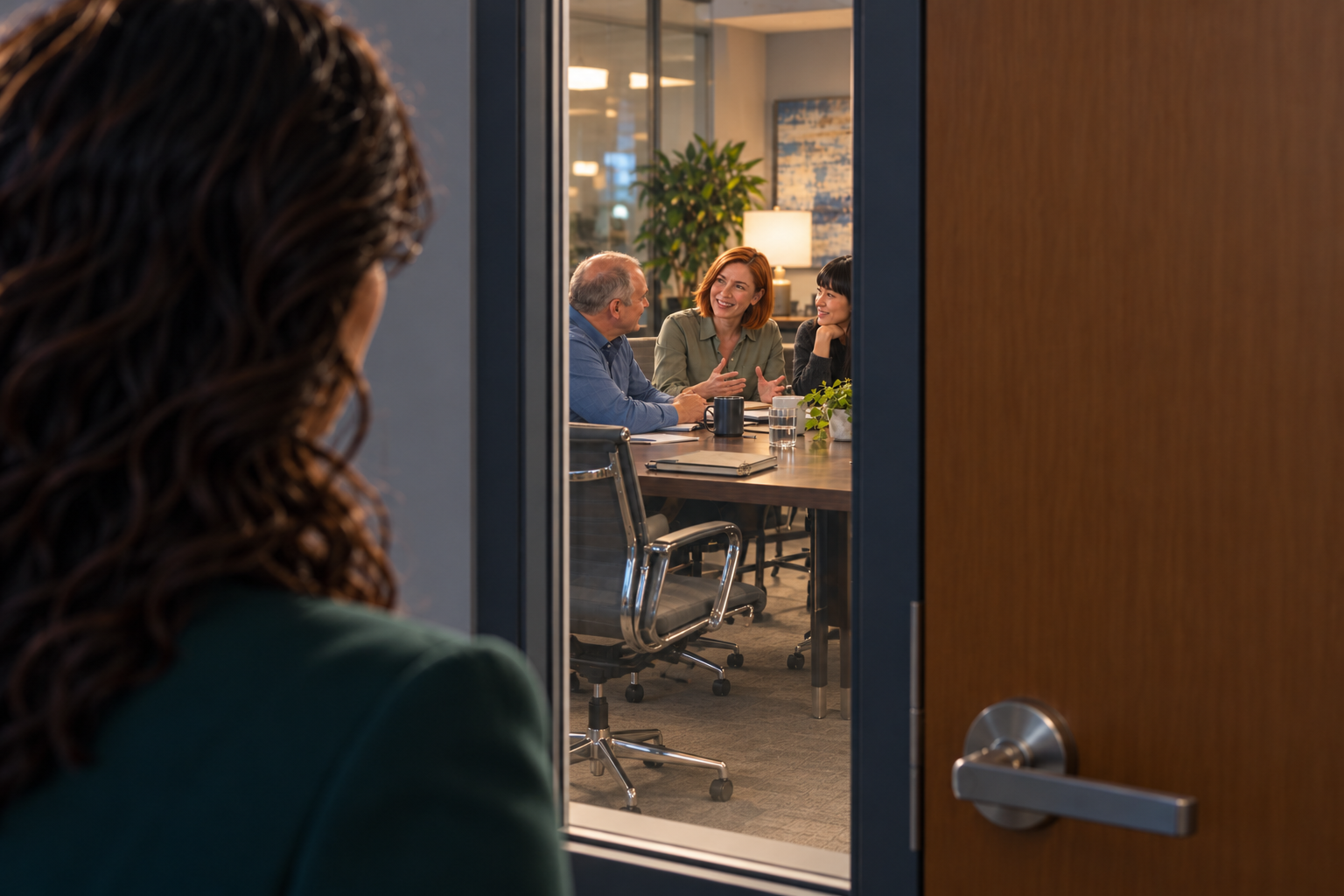
Maya heard the laughter before she reached the project room.
It was a familiar sound. Marcus laughing reluctantly, as if he had reviewed the joke for accuracy before allowing it. Lena saying something too quietly for Maya to catch. Then another laugh, louder this time.
For a moment, she felt the small lift she always felt when her team sounded like themselves.
She pushed the door open.
The laughter stopped.
Not abruptly enough for anyone to be accused of it. Marcus still had a smile on his face. Sofia looked up, then down at the table. Lena straightened in her chair.
“Morning, Maya.”
There was nothing wrong with the greeting.
Maya would think about that later. How little there was to point to. A chair turning toward her. A notebook opening. Her own name spoken with just enough care to make her feel the distance it had crossed.
“Morning.”
She had been about to ask what was funny. The question was ready, familiar, hers. She had asked it a hundred times while coming into this room, sometimes knowing she was the last person to understand the joke and enjoying the way they made her work for it.
Now she could not quite say it.
Lena moved her cup away from the chair beside her.
“We've been talking about the improvement work.”
“Of course.”
Maya sat down.
She knew why they were talking about it. Yesterday she had recommended moving Lena's time to the pilot. The decision had been approved. Their improvement project would pause, including the testing they had worked so hard to get ready for.
There had been good reasons. There were still good reasons.
She had brought them into the room with her, and for the first time they felt like something she was carrying between herself and everyone else.
Marcus's chair was still angled toward Lena. So was Sofia's. Before Maya arrived, they had made a small, loose circle at one end of the table. Lena sat in the middle of it with one sleeve pushed up, a pen tucked behind her ear, and the expression Maya knew from a conversation going well.
Maya had seen that expression more often lately.
She had wanted to.
There had been a time when Lena would have waited for her before beginning, when even a good recommendation arrived with an apology around its edges. Maya had worked to change that. She had asked better questions. She had waited when it would have been easier to answer. She had watched Lena discover that the room could hold her point of view.
Now it did.
Maya felt proud of her, and then felt the ache underneath the pride, and was ashamed of how quickly the two had found each other.
She wanted Lena to have a place of her own. She had not realized she expected to keep precisely the same place beside her.
“Marcus was saying something before you came in,” Lena said.
Maya looked at him.
He shook his head. “It's fine. We can move on.”
“No,” Lena said, gently. “Finish.”
It was something Maya might have said.
Marcus glanced at her, then back at Lena.
“I was saying I don't know what to tell the people who helped us get it ready. They finally saw it coming together.”
Maya's hand moved toward her notebook. She knew the answer she could give. The review in thirty days. The work preserved. The distinction between pausing something and abandoning it.
Lena spoke before she did.
“I think we tell them that. That it was coming together.”
Marcus nodded.
“And that we're disappointed too,” Lena added.
Maya kept her hand on the closed notebook.
There it was. The conversation she had walked into. Not a complaint to resolve or a question awaiting her answer. People trying to understand what had happened to work they cared about.
They had been able to laugh a minute ago.
Now they were watching her to see what could still be said.
She wanted to tell them they did not have to do that. She was the same person. She still knew which late client call had kept Marcus at his desk last week, still knew why Sofia distrusted an encouraging number without its denominator, still recognized the small lift in Lena's voice when she had found a sentence a manager could actually use.
None of that had disappeared because her title had changed.
But she had come into this room with a choice that belonged to a larger conversation, and they were living with its cost. Asking them to act as though nothing had changed would make the room easier for her. She could feel how much she wanted that.
“Yes,” she said. “We should tell them that.”
Lena looked at her for a moment, then nodded.
Maya waited for the nod to feel like more than a nod.
It didn't.
The meeting continued. Lena showed them the work, as they had agreed. Maya could have described most of it without looking at the screen. She remembered the conversations behind it, the pieces that had seemed stuck, the afternoon someone finally found a way through.
Watching Lena now, she found herself remembering a different afternoon. Lena at Maya's desk, worried about how to tell a client something unwelcome. Maya had moved her own work aside and pulled up another chair. They had stayed with the problem until Lena laughed at the version she had almost sent.
That had been easy closeness. Useful, too. Maya had known how to be good in that room.
Today, Lena did not need her to make the language better. She needed Maya to hear that the decision hurt without improving the hurt into something more acceptable.
Maya was not sure how long she could do that before someone noticed the effort.
At the end, she reminded them of the review. Briefly. The date mattered. She would keep it.
Then she asked Lena to spend some time with her on Thursday.
“To see how it's going,” she said.
Lena agreed. Her voice was professional, not unfriendly.
Maya had never known how lonely that distinction could feel.
She left the room before the others. In the corridor, she slowed without meaning to. She could hear Lena speaking again. She could not make out the words, only the changed rhythm. Less careful. Someone answered.
Then Marcus laughed.
Maya kept walking.
She was due in Elaine's office. She had asked for ten minutes after the reset because she had known yesterday that she would need somewhere to put this.
Yesterday had been more sensible than today. Today she wanted to cancel.
She wanted to sit at her desk until her face felt ordinary again, then send Elaine a concise update about a productive discussion. It had been productive. Nothing in that sentence would be a lie.
She reached Elaine's doorway and stood there with her notebook held against her.
Elaine looked up.
“Come in.”
Maya sat. For a few seconds, she said nothing.
“What happened?” Elaine asked.
“They were different with me.”
There. No executive framing. No graceful route into it.
Elaine put down her pen.
Maya looked at the corner of the desk rather than at her.
“I knew they wouldn't like the decision. I don't know why I expected them to feel the same about me.”
“Do you know that they don't?”
“No.” Maya looked up. “But the room changed when I came in. I could feel them choosing what to say.”
Elaine listened.
Maya had come ready to explain the staffing choice again if she needed to. She had not come ready for someone to leave the choice alone and hear the rest.
“I don't want to lose them,” she said.
Her voice caught on the last word. She looked down quickly, irritated by the timing, by the ordinary bright office, by the fact that she had made it through much harder meetings without this happening.
Elaine did not reach for a lesson.
“You care about that team,” she said.
Maya nodded.
“And now I get to be the person they talk about after the meeting.”
“Sometimes.”
Maya let out a small, uneven laugh.
“I was hoping you might lie.”
“I thought about it.”
The silence afterward was easier.
Maya did not explain everything. She told Elaine about Lena asking Marcus to finish, about being proud of her, about how unprepared she was for the rest of what she felt. Elaine stayed with her for the ten minutes she had asked for.
When Maya left, the ache had not gone away. But she had said something true without first turning it into a problem she knew how to solve.
She carried that small relief until lunch.

Maya was waiting beside the elevators when Omar came around the corner, looking at a message on his phone.
“Heading down?” he asked.
She nodded, holding up the granola bar she had not yet opened. “Eventually.”
He smiled and pressed the button. The doors opened almost immediately. He stepped inside, then glanced back.
“Hey, you want to join us? We're having lunch downstairs.”
The invitation was casual. An afterthought. Maya could tell, and wished she had not noticed.
“Sure.”
Omar held the door while she stepped in.
In the cafeteria, she followed him toward a table near the windows. Natalie was there with several other directors. Maya recognized everyone. She knew their names, their functions, the voices they used in meetings.
She had never seen one of them laugh with his head tipped back like that.
There was one empty chair.
Omar pulled it out, then stopped.
“Let me find another.”
“Oh, here,” Natalie said, moving her tray. “We can make room.”
People shifted. A bag came off the floor. Someone slid a plate toward the middle of the table while Omar borrowed a chair from the next one.
Maya stood with her hands around her lunch, trying not to feel as though she had interrupted something by needing a place to sit.
“There's plenty of room,” Natalie said.
There was, once they had moved.
Maya thanked her and sat down between two chairs that had been comfortably spaced a moment earlier.
The conversation had barely paused.
“No, that was the second time,” one of the directors said. “The first time, he still thought we were going to believe him.”
Omar laughed before anyone explained who they meant.
Natalie shook her head. “I had forgotten that.”
“You were sitting right there.”
“I've made an effort.”
The table laughed again.
Maya smiled, watching for enough of the story to join it. There was a trip, apparently, or a dinner after a meeting. Someone had said something that had become a phrase they still used. They did not need to finish the sentences. A name, a look, and everyone knew where they were.
She knew these people with agendas in front of them. She knew where they disagreed, which questions they asked, how quickly they wanted an answer. Here, they interrupted one another without caution. They remembered details from one another's lives. They could be ridiculous without first establishing that they were competent.
Maya unwrapped the granola bar beneath the edge of the table, where the sound would be less noticeable.
She had wanted to be part of this group. Not this lunch, exactly. The conversations. The ability to help shape a decision instead of waiting for it to reach her team.
She had thought about what she would need to know to sit with them.
She had not thought about all the things they already knew about one another.
Natalie turned toward her.
“How are you finding it?”
Maya looked up.
“The new role.” Natalie's expression was warm. “We should get coffee sometime. Have a chance to catch up.”
“I'd like that,” Maya said.
Someone farther down the table said Natalie's name.
“Wasn't that the same night you…”
“Oh, absolutely not,” Natalie said, turning toward him. “You don't get to tell that version.”
The others were already laughing.
Maya's answer to the first question remained somewhere behind her ribs.
She had not decided what she would have said. Fine, probably. Busy. Something light enough to set on the table without changing its mood.
But for a moment, when Natalie asked, she had wanted to answer.
She took a bite and listened.
No one was excluding her on purpose. That was almost harder to sit with. There was no slight she could dismiss, no unkind person whose opinion she could decide did not matter. They had moved their chairs. They had made room. Omar had thought to invite her.
The ache came from how much had existed before she arrived, and how little a new title could do about that.
Upstairs, she had walked into a room where she used to belong without thinking and felt people draw back.
Down here, she was close enough to hear every word and still could not find a natural place for her own.
She glanced at Omar. He was leaning forward, arguing cheerfully about some detail of the story. In meetings, his humor often gave Maya a way into a difficult conversation. Here it belonged to a rhythm already in progress.
She did not want him to stop and look after her. That would make the feeling worse.
She wanted to know how to be here without needing to be looked after.
Lunch ended gradually. A phone was checked. Someone remembered a meeting. Chairs moved back and the group loosened into smaller conversations on the way to the elevators.
Maya walked beside them, quiet, carrying the uneaten half of the granola bar.
She had been invited. She had sat at the table.
She could not have explained why she felt so far from everyone.

That evening, she sat in her car outside the house longer than she needed to.
The kitchen light was on. Through the window she could see her husband, Samir, moving between the counter and the table, carrying something in both hands. One of the kids passed behind him. A familiar shape, a familiar room.
She had looked forward to coming home all afternoon.
Now that she was here, she did not know what to bring through the door.
There was no crisis to describe. No person to blame. She could tell Samir about the paused project, but then he might ask whether she thought she had made the right choice, and she did. She could explain that her team had been quieter with her, but saying it that way made it sound small.
She was a grown woman with a good job and people who loved her. She had spent the day longing for someone to speak to her without being careful, and now she was rehearsing how to make herself easy to receive.
Maya took the keys out of the ignition.
Inside, her son, Rohan, was standing beside the table, one hand wrapped around a wooden spoon.
“Whose sandwich is in my drawer?”
Samir looked up from a plate.
“An excellent question.”
“No, you're supposed to say it.”
“I thought I just did.”
“Like him.”
Maya put her bag down.
“What did I miss?”
Samir smiled at her. “A broadcasting incident.”
The kids began telling her at once. A teacher at school had finished an announcement, thought the microphone was off, and asked someone about a sandwich. Rohan was certain the entire school had heard. His older sister, Anika, believed the story had acquired an audience since breakfast.
“Everyone heard,” Rohan insisted.
“Everyone you asked.”
“That's everyone.”
Maya laughed.
For a moment, she was simply there.
Samir moved a pile of papers from the chair beside him. There was a plate for her, still warm. He touched her back as he passed, the small familiar contact she barely noticed on other evenings.
Tonight she wanted to lean into it. She stayed standing instead, taking off her jacket, putting it somewhere sensible, doing the small things that allowed her another moment before she had to sit down.
Rohan handed the spoon to Samir.
“You do it.”
He lowered his voice with considerable seriousness.
“Whose sandwich is in my drawer?”
Both kids collapsed into laughter.
“That was exactly your normal voice,” Anika said.
“It is a versatile instrument.”
Maya smiled. She could feel herself smiling.
That was the thing she could not seem to stop noticing today. Every response had a little observer attached to it, checking whether it was right. At work, she had watched herself being steady. At lunch, she had watched herself trying to belong. Now she was watching herself enjoy her kids.
She wanted to disappear into the evening. To be hungry, amused, mildly irritated by the papers on the table. To know without effort which kid was exaggerating and which line in the story Samir had already heard six times.
Instead, she was catching up.
Anika turned a sheet of paper toward her.
“Look.”
Maya leaned closer. A school project. The title had been written in careful large letters, then outlined again in another color. She recognized the concentration it must have taken. She knew the hand that had done it.
“This is good.”
“Do you think this bit is too small?”
She looked where the finger was pointing.
“No. I can read it.”
“Dad said I should make it bigger.”
Samir raised both hands. “An opinion, not a ruling.”
Maya smiled and looked back at the page.
“Is it due tomorrow?”
“Thursday.”
“Right.”
“I told you.”
Anika had already turned away, reaching for the paper. No injury intended. A date corrected. The evening moving on.
Maya let go of the page.
She could not remember being told.
She could remember the exact sentence Karen had used to approve the staffing transfer. She could remember the order of the three resource scenarios. She could remember Lena's face yesterday when the testing slot was lost.
Somewhere, Anika had told her something that mattered enough to say out loud, and she had received it without keeping it.
Maya reached for her water.
It would be easy to turn this into a question of hours. She knew how to solve for hours, at least on paper. Leave earlier. Close the laptop. Put the phone away.
Her phone was in her bag. The laptop was closed. She was sitting at the kitchen table with both hands free.
Across the table, Samir caught her eye. His expression changed slightly. He did not ask in front of the kids.
She was grateful, and then wished he had asked, and then felt tired of needing things she could not quite name.
After dinner, the kids went upstairs. A chair scraped. A cabinet closed. The house settled into the familiar sequence of an evening nearing its end.
Maya stayed at the table with the school project in front of her.
Samir sat down beside her, in the chair Rohan had left.
“Hard day?”
She almost said busy.
The word was so available. It explained nothing and invited very little. People understood busy. They gave it space.
“I think so.”
He waited.
“I don't know how to tell you about it.”
“You don't have to do it in order.”
That undid something.
She looked at him and found she could not begin with the decision, or the team, or the promotion. All she could say was, “I miss you.”
His face softened.
“I miss you too.”
The answer hurt. She had wanted him to say there was no need, that he was right here, that nothing had changed at home. Instead he had told her something true.
She looked down at the page between them.
“I was sitting here tonight and I couldn't get here. Does that make any sense?”
“Yes.”
“I wanted to. I spent the afternoon wanting to come home.”
“I know.”
He rested his forearms on the table.
“Sometimes I can tell you're still somewhere else. I don't always know whether asking will help or just give you one more thing to answer.”
Maya pressed her lips together.
He knew her. That was the comfort and the pain of it. He knew the version of her who answered, handled, reassured, then returned to whatever still needed doing. She had brought that version home so faithfully that even here, where she did not have to earn her place, people were learning when to leave her alone.
“I don't want you to stop asking.”
“Okay.”
“I might not have a good answer.”
“I wasn't grading them.”
She laughed, but the sound broke halfway through.
A small tear rolled down her cheek and she wiped it away. Samir moved closer. He put his hand over hers and let her find the next sentence.
“I wanted this job so much.”
“I remember.”
“I still want it.”
“I know.”
“But I feel like I've left somewhere, and I don't know where I'm supposed to be now.”
She told him about the laughter. About Lena, who was becoming exactly the leader Maya had hoped she would become, and how that could make Maya proud and leave her feeling unnecessary in the same breath. About the people at lunch who had shifted their chairs to make room for her, and how she had sat among them without finding a way into the conversation.
She stopped before telling him what she had learned.
She had not learned it yet.
He stayed beside her.
After a while, he asked, “Do you want me to say something, or just stay here?”
“Stay here.”
So he did.
Upstairs, a door opened. Rohan called for help finding something. Samir looked toward the ceiling, then at her.
“I'll go,” Maya said.
“You don't have to make up for the whole day tonight.”
“I know.”
She wasn't sure she had known until he said it.
“But I want to see them.”
He squeezed her hand and let go.

The missing thing was on a chair. Maya found it without difficulty and received the brief astonishment kids reserve for parents who can see objects in plain sight.
She sat on the edge of the bed.
For a little while, there was nothing to discuss. A book lay open. A foot pushed against her leg beneath the covers. Downstairs, Samir was moving dishes, the sound softened by the floor between them.
Maya rested her hand on the small shape of the foot.
She had been so afraid of missing something important that she had almost missed this too. Nothing happening. No story to catch up on. Just a place beside someone she loved.
She stayed until Rohan asked whether she was going to read or merely sit there looking strange.
“Those were my two options?”
“There might be others.”
Maya picked up the book.
The next day, Maya closed her office door and called Thomas. Instead of sitting behind her desk, she took the visitor’s chair on the opposite side. Her computer screen faced away from her. She could not watch for messages from there.
She held the phone to her ear. Thomas heard something in her voice before she had finished saying hello.
“What happened?”
Maya leaned back in the visitor’s chair.
“I got promoted.”
“I had heard.”
“I think I'm only just finding out.”
He was quiet for a moment.
“Tell me.”
She told him less about the work than she usually did. He knew the decision. What she needed to explain was everything that had happened around it, most of which would not have looked like much to anyone else.
When she reached the end, Thomas did not ask what she would do differently.
He said, “You miss knowing where you fit.”
Maya looked at the empty space behind her desk.
“Yes.”
The word seemed too small for the relief of being understood.
“With the team, I knew. Even on the hard days. Especially then, maybe. I could help. They wanted me there.”
“Do you think they don't want you there now?”
“I think sometimes they want to talk without me.”
He did not contradict her.
“I hate that I mind,” she said.
“Why?”
“Because I wanted them to be stronger. I wanted Lena to lead. I don't want to be the person who only likes that when I am still in the middle of it.”
“Do you only like it then?”
“No.”
“What did you feel when you saw her?”
“Proud.” Maya swallowed. “And left out.”
Thomas gave the two feelings room.
She was used to taking the less attractive feeling and finding something useful to do with it before anyone could see. Naming it without immediately correcting it felt almost indecent.
“I don't want to make that her problem,” she said.
“You're talking to me.”
Maya closed her eyes.
“Yes.”
“You talked to Elaine. And your husband.”
“Yes.”
She could hear what he was leaving for her to notice. There were people she could tell. It did not have to go back into the room where Lena was trying to lead.
That did not make the room hurt less. It gave the hurt somewhere else to be held.
“What are you afraid happens if it stays different?” Thomas asked.
Maya thought about it.
“That I become someone they have to manage. Someone who arrives and everyone sits up straighter. Someone who gets the version they think I can hear.”
“What would you want them to know instead?”
“That they can still tell me.”
“Have they?”
“Yes. Lena did.”
“What happened in you when she did?”
“I started explaining.”
She remembered her hand moving toward the notebook. The reasons waiting. How quickly she could find shelter inside a well-made decision.
“I wanted her to know I hadn't done it carelessly.”
“Does she think you did?”
“I don't know.”
Maya opened her eyes.
“I didn't ask.”
They were quiet together for a while.
Then Thomas asked about the other directors.
Maya nearly laughed. “That is not a more flattering story.”
“I wasn't promised one.”
“I think they know how to do this. How to be here without wondering where they fit.”
“Which of them have you asked?”
“None.”
“An admirably efficient study.”
She smiled.
“I know.”
“You know them at work,” he said. “You're still getting to know them as people.”
“I don't want to arrive needing help.”
“Too late, I'm afraid. They met a person.”
Maya really laughed then, enough to loosen her shoulders.
After the laughter faded, she could feel the fear underneath. Not that her peers would refuse her. That they would see how much the new role mattered, how badly she wanted to do it well, how little the title had settled inside her yet.
It was easier to be useful than to be known that way.
“I don't think I can make myself feel at home by tomorrow,” she said.
“No.”
“I might be able to stop pretending I already do.”
Thomas let that stand.
They spoke a little longer. There was no exercise, no sentence she had to write down. When the call ended, Maya stayed in the unfamiliar chair and let herself feel the room around her.
She had earned the office. She had earned the responsibility. She could want both and still miss what had felt simple before.
She wished that understanding felt more like arrival.
It felt, for now, like being allowed to stop walking for a moment.
On Thursday, Lena came to the conversation Maya had promised to keep.
She sat across from the desk with her notebook closed.
Maya noticed that. The same way she noticed the tea Lena had brought, the careful ease of her greeting, the fact that they were both trying.
“How are you?” Maya asked.
“Good.”
Maya nodded.
She had given that answer enough times this week to recognize how many things could live inside it.
They talked about the work for a few minutes. It was moving. There were difficulties, but nothing Lena was asking Maya to rescue. She and Priya had found their way through a question the managers were struggling with. Lena described it clearly, with a little pleasure in what they had made possible.
Maya enjoyed listening to her.
She had been missing this while measuring every exchange for what it meant about their relationship.
Then Lena mentioned the paused project, and Maya felt the explanation rise again.
She stopped before giving it.
“I keep telling you why,” she said.
Lena looked up.
“When you talk about the work we stopped. I keep telling you why I made the recommendation.”
There was a pause.
“Yes,” Lena said.
The plainness of it hurt more than an accusation would have.
“I think I wanted to be sure you understood.”
“I do understand.”
Maya waited.
“I don't agree with all of it,” Lena said. “But I understand.”
Her voice was steady. Maya could hear how much stronger it had become. This time the pride did not have to wait for the ache to go away.
“What have I made harder to say?” Maya asked.
Lena's eyes moved to the notebook, then back to her.
Maya wanted to soften the question. Tell her it was all right. Make a little joke so they could both relax.
She left it alone.
“Sometimes I don't have a different answer,” Lena said. “I'm just trying to tell you what it's like.”
Maya looked at her.
There was something painfully familiar in the sentence. She had sat at her own kitchen table trying to say almost the same thing.
“I haven't left much room for that.”
“Some,” Lena said. “Not always.”
Maya nodded slowly.
She could not ask Lena to give her the old ease back. She could do something about the room they were in now.
“Tell me,” she said.
Lena opened the notebook, then closed it again.
When she began, Maya listened without reaching for hers.
Later, Maya would need to consider what the conversation meant for the work. There were questions about how her requests were being heard, what people believed they needed to have ready before coming to her. She would need to look at those carefully rather than turn one difficult week into a conclusion about her leadership.
For now, Lena was talking.
Maya stayed with her.
That afternoon, she sent Natalie a message asking whether they could find a time for the coffee Natalie had suggested at lunch.
Natalie replied almost immediately.
Yes. Do I need to bring anything?
Maya started to type a sentence about the pilot.
She deleted it.
No. I'd like to talk about how strange this has felt. You asked how I was finding the role at lunch, and we never got back to it.
She looked at the message long enough to feel exposed by it.
Then she sent it.
There was no sudden relief. The office looked the same. The team was still disappointed. Somewhere at home, there would be a story she had not heard yet.
Maya put the phone down without opening another document.
For a moment, she let herself want the reply.
Executive Truth
You can be ready for the role and still need time to feel at home in it.
Executive Reflection
What do you miss about the place you knew before your role changed, even as you value what is becoming possible now?
Where are you working so hard to appear settled that people who care about you cannot see how you actually feel?
What might someone be trying to tell you about their experience that you are answering with an explanation of your intentions?
Executive Practice
Give yourself time to arrive
Think of a change you wanted that has felt different from what you expected.
Take a quiet moment to finish this sentence, just for yourself: “I’m glad I took this step, and I miss…”
Stay with what comes up before deciding what to do about it. It might be the ease of a familiar room, time with people you love, or knowing where you fit without having to think about it.
You do not have to choose between valuing your growth and acknowledging what has changed. For now, let both be true. Give yourself time to find your place without asking yourself to feel settled already.
Copyright © 2026 Finley-RE Coaching and Consulting LLC. All rights reserved.
The Unshakable Executive is a trademark of Finley-RE Coaching and Consulting LLC.


